
What is hard money lending?
A builder finds a small property with a sound location and a damaged interior. The seller wants to close in three weeks. The property needs enough work that a long-term rental loan may not fit yet. A private lender offers to finance the purchase and part of the renovation, with repayment due after the property is sold or refinanced. That is the kind of deal people usually mean by hard money lending.
The name is loose. Lenders also use bridge loan, private money loan, and fix-and-flip loan. Some finance only business-purpose, non-owner-occupied property; some handle land or new construction; others focus on rentals. The loan agreement matters more than the label. Kiavi’s bridge program and Anchor’s renovation program show two examples of how lenders describe these products, not a common set of terms for the whole market.
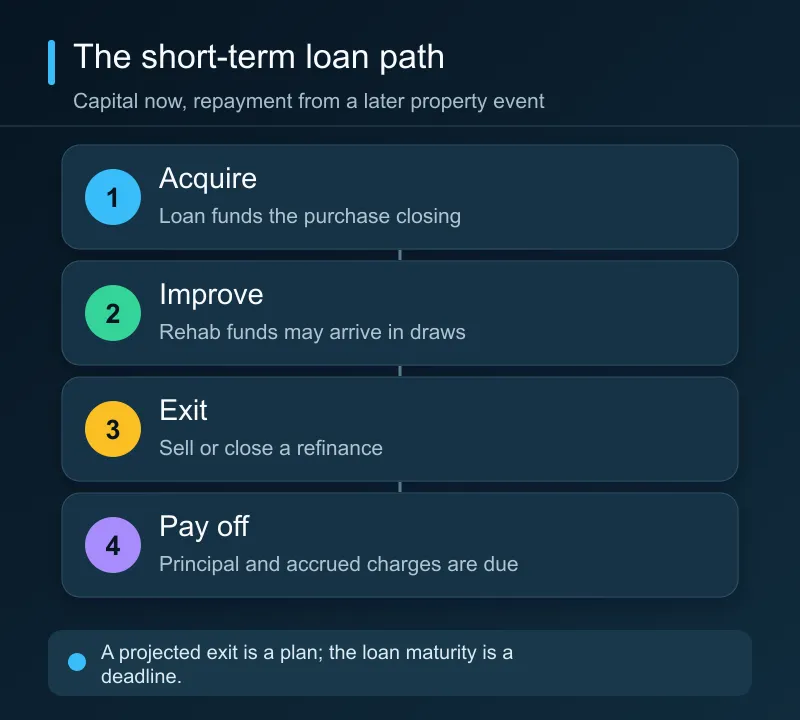
The repayment event comes after the work—and can take longer than the construction schedule.
What makes the loan different?
The lender looks closely at the collateral and the deal: the property’s condition and value, the purchase price, the work to be done, the borrower’s experience and available cash, and the route to repayment. That does not mean credit or borrower finances are irrelevant. A lender still needs confidence that the project can be completed and the debt repaid.
Many of these loans are short-term. A renovation loan may deliver purchase money at closing but hold back construction funds for later draws. Payments during the term may cover interest without reducing principal. When the property sells or the loan matures, the remaining principal is due. Other payment and funding structures exist, so request a calendar showing the actual amounts and dates for your offer.
The useful feature is that financing can match a property in transition: acquisition, repairs, lease-up, or a pending sale. The tradeoff is a firm payoff date and costs that may be substantial over a short hold. Interest, origination points, title and legal charges, inspections, insurance, taxes, and extension fees can change the economics. The cost guide shows how to put them on one sheet.
A simple funding picture
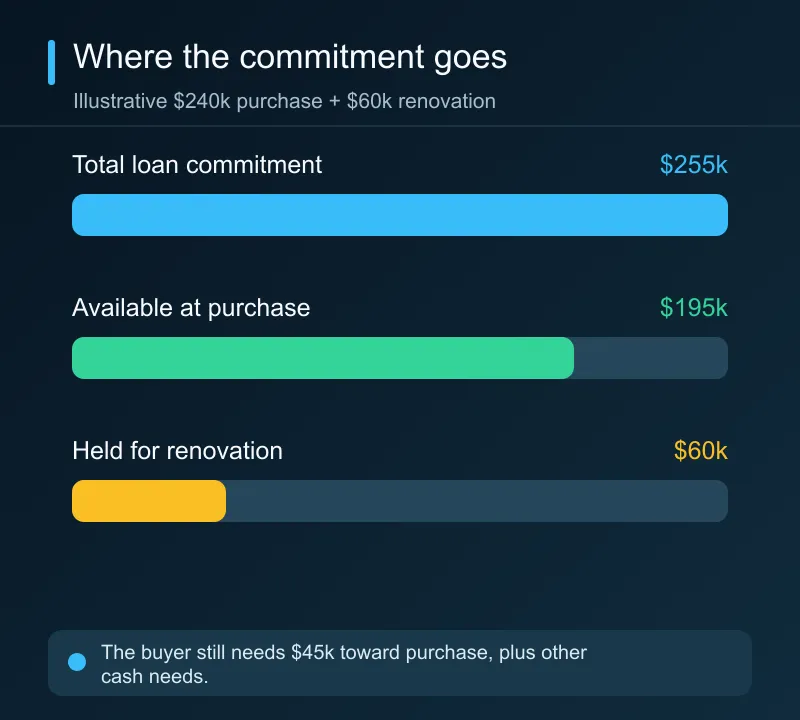
A loan commitment is not the same as cash delivered at closing; this example excludes closing costs and early construction cash.
Suppose a project costs $240,000 to buy and $60,000 to renovate. A lender approves a $255,000 total commitment, including a $60,000 rehab holdback. Only $195,000 would be available toward the purchase at closing if the full holdback is reserved. The borrower needs at least $45,000 for the purchase gap, plus closing costs and perhaps cash to start work before the first draw. “Loan amount” and “cash available today” are not interchangeable. We work through the leverage math in LTV, LTC, and ARV.
The question to settle before borrowing
How will the loan be paid off? For a flip, estimate the net sale proceeds after selling costs and the lender payoff. For a rental, find out what a future refinance lender will require and how much that loan could actually provide. Add time for construction, marketing or leasing, underwriting, and closing. A projected finished value is not money already available to repay debt.
If the project slips, interest keeps accruing and an extension may require a fee, a paydown, or fresh approval. The FDIC’s commercial real estate guidance, written for banks, identifies weak liquidity and repayment that depends on property appreciation as credit concerns. The same questions are useful for a borrower sizing a project.
Before signing, make sure you can explain five numbers in your own words: cash needed at closing, cash needed before construction draws arrive, the monthly carrying cost, the maturity date, and the payoff under a slower exit. If the lender’s written terms cannot support that explanation, the deal is not ready.
This guide concerns investment-property financing. A home you occupy can be treated differently; the CFPB’s business-purpose guidance shows why how the property is used matters.