
What does a hard money loan really cost?
A builder can compare two loan quotes only after deciding how long the money will be outstanding and how much cash each quote actually supplies. A rate alone hides the price of a short-term loan. One offer may charge fewer points but interest on the full construction commitment from day one; another may start charging on rehab funds only when they are drawn.
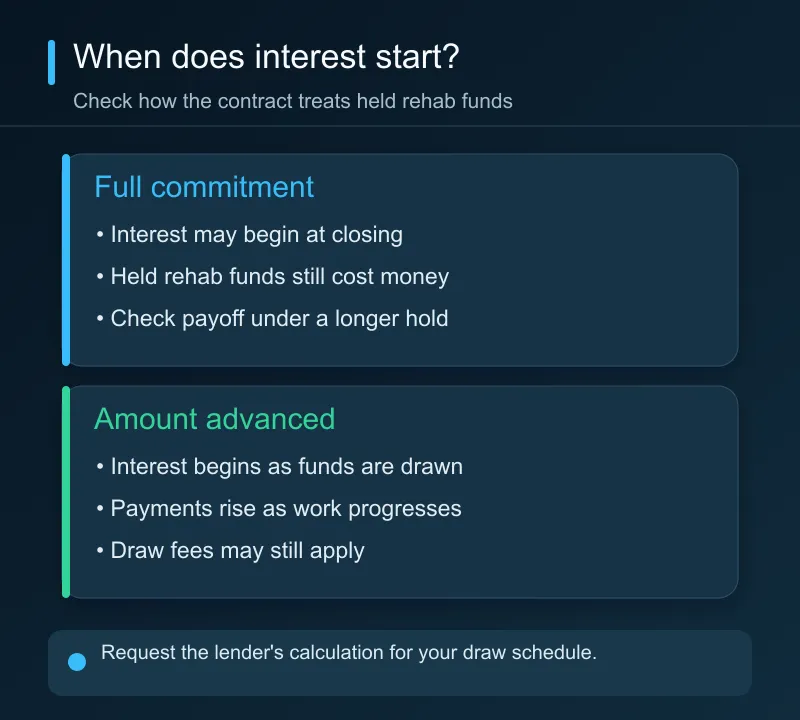
The interest basis on held construction money can change the cost of two otherwise similar offers.
Separate the costs
Make one column for lender and broker charges: origination points, underwriting or processing fees, servicing and draw fees, extension fees, and any minimum-interest or early-payoff charge. Make another for third-party closing costs such as title, valuation, legal work, recording, and required insurance. Keep property carrying costs—taxes, utilities, maintenance, insurance after closing—in a third column. They are not all charges for borrowing, but they all consume project cash while the loan is open.
In many quotes, one point means 1% of the amount on which it is charged. Two points on a $300,000 loan would be $6,000. Confirm the calculation base and whether the charge is paid in cash, withheld from proceeds, or financed. The CFPB explains the one-percent convention for consumer mortgage discount points; private-loan origination points are a different type of charge, so use the dollar figure in the actual quote.
Price the time you may need
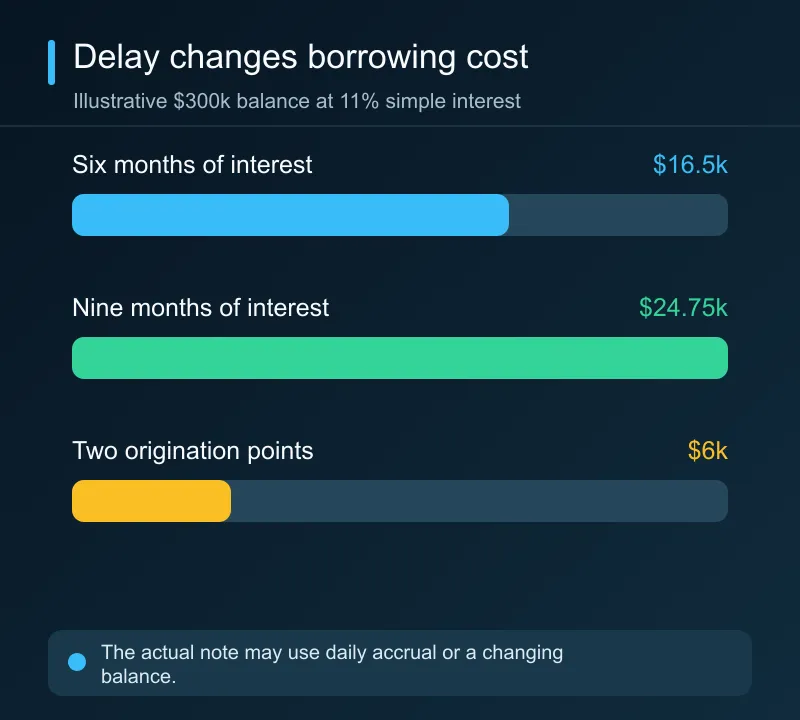
Three extra months add about $8,250 in interest in this simplified example, before extension charges.
Suppose a $300,000 balance stays outstanding at an illustrative 11% annual simple rate. Six months of approximate interest is $16,500. Add two points and the borrowing cost reaches $22,500 before other fees. A nine-month hold raises interest to about $24,750; the extra three months add $8,250, plus any extension charge. This simplified example assumes a constant balance and ignores daily-accrual details. The lender should give you its payment method in writing.
For construction money, draw timing changes the interest calculation. If the lender holds $60,000 for rehab, ask whether interest starts on the full commitment at closing or on each amount when released. Also ask whether a draw fee applies each time and how much cash the contractor needs before reimbursement. An apparently generous commitment can still leave a cash shortage on day one.
Compare what happens at payoff
Request two payoff examples for each offer: one at the expected sale or refinance date, another after a realistic delay. Include principal, accrued interest, unpaid fees, extension costs, and any early-payoff provision. If the exit is a sale, subtract brokerage fees, transfer costs, and concessions from the sale price before comparing proceeds with the payoff. If the exit is a refinance, include the new loan’s costs and possible cash gap.
A lower rate with higher upfront fees may be cheaper on a long hold and more expensive on a short one. The reverse can also happen. Put both quotes on the same dates and with the same draw schedule. The answer is the total dollars you expect to spend—and the cash you must have available along the way—not whichever headline percentage is smaller.