
Hard money vs. conventional investment loans
A loan should fit the job the property needs to do. A builder buying a vacant house with a failed roof has a different financing problem from an investor buying a leased fourplex. Both may be called investment-property purchases, but the first needs construction money and a short path to sale; the second may need a loan designed to be held for years.
Hard money and conventional are broad labels, not two standardized menus. The useful comparison is between a specific short-term private offer and a specific long-term mortgage or rental-loan offer for the same property and plan. Kiavi, for example, describes separate bridge/fix-and-flip and rental products. Other lenders may draw the line differently.
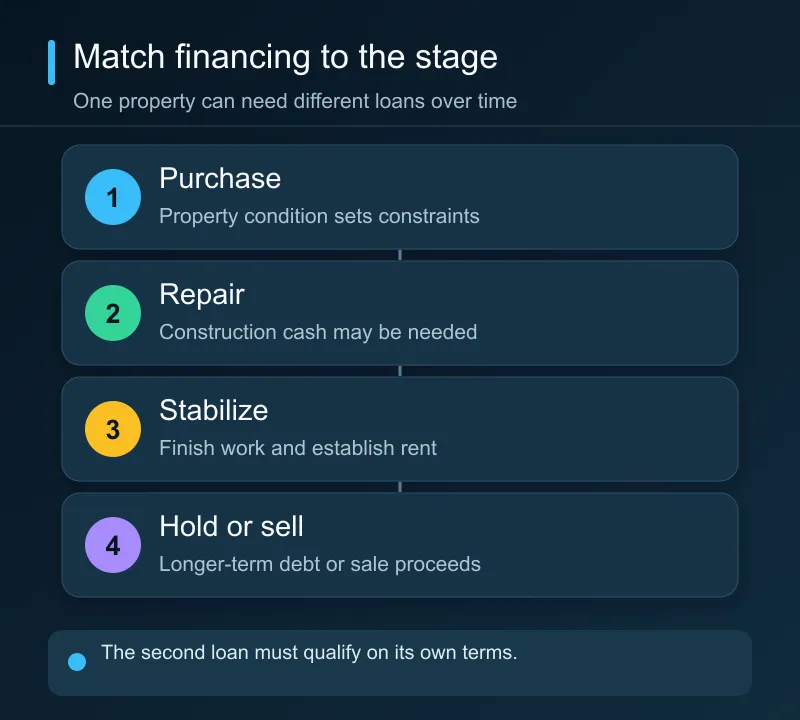
The financing question changes as the property moves from a work site to a stable rental.
When a bridge loan fits
A short-term loan can help an investor purchase a property that needs substantial work, close on a compressed seller deadline, or finance an improvement plan before sale or refinance. Its underwriting may put more weight on the project and collateral than a long-term mortgage program does. That does not remove borrower, liquidity, title, or insurance requirements.
The financing often has a maturity date tied to an expected exit. Payments may be interest-only while the principal remains outstanding. Construction money may sit in a holdback and come out in draws. These features can match the work, but they also mean a borrower needs enough cash to close, pay contractors between draws, carry the property, and repay the loan if the sale or refinance is late.
When longer-term financing fits
If the property is ready to rent and the investor plans to hold it, a longer-term loan may avoid paying for a short-term closing and then paying again to refinance. Depending on the program, the lender may focus on borrower income, property rent, condition, appraisal, reserves, or a combination. It may amortize over time or offer other payment structures. The lower monthly payment advertised for any loan is not enough to judge its total cost.
For a property that needs rehab before becoming a rental, the choice is sometimes a sequence: bridge loan to buy and finish work, then a rental refinance. Test the second loan before committing to the first. Suppose the bridge payoff at month 12 could be $310,000. If a conservative appraisal and rent support only $285,000 in net refinance proceeds, the investor needs $25,000 more to close the gap, plus whatever cash is needed to complete the project. Our bridge-to-rental guide takes that calculation further.
Compare a whole project, not one rate
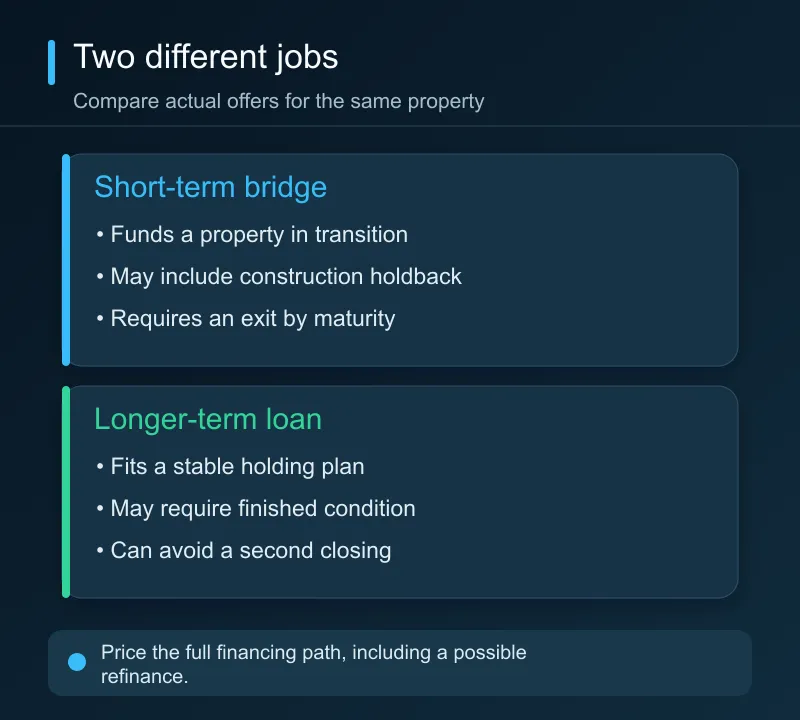
Neither loan label is a verdict. Match the structure to the condition, schedule, and exit.
Put both paths on one calendar. Include acquisition closing costs, interest while the property is held, origination charges, construction draws, taxes and insurance, and any second closing. Check prepayment terms and what a delayed exit costs. The CFPB’s comparison guide is written for covered home mortgages, but comparing offers on the same amount and time horizon is sound practice here too. A business-purpose investor loan may not use the CFPB’s standardized Loan Estimate.
A conventional loan can be the wrong tool for a property that cannot meet its conditions today. A bridge loan can be the wrong tool for a property the investor can already finance for the long haul. Write down what must happen before the debt is repaid, and choose the structure whose deadline leaves room for that work.