
Choosing a hard money lender
Two lenders can quote the same rate and leave a builder with very different amounts of cash at closing. One may fund the purchase and reimburse construction later; another may release some construction cash up front. One may decide credit in-house; another may still need an outside capital partner’s approval. Start with the financing your project needs, then compare the offers.
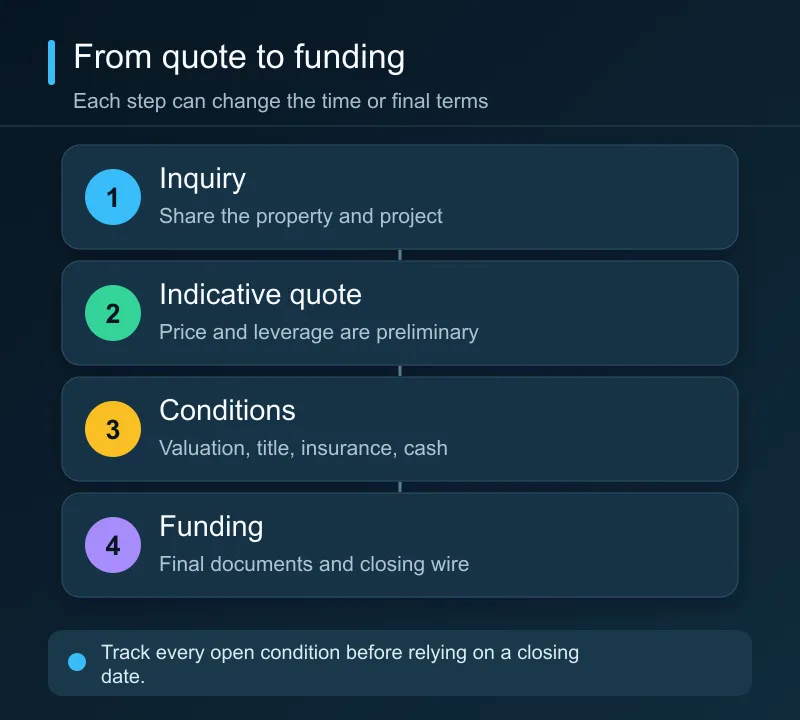
A quick quote begins the process; the remaining conditions determine whether the closing date is realistic.
Narrow the field before applying
Tell each lender the property address and type, purchase contract deadline, intended use, rough scope of work, total budget, and exit plan. Confirm that it lends in the property’s state and handles that type of project. A company that makes rental loans may not finance a vacant shell; a fix-and-flip program may not support ground-up construction. Ask who will originate and fund the loan, whether a broker is involved, and who will service it after closing.
A preliminary number is helpful, but it is not a commitment. Ask what remains to be checked: valuation, title, borrower or entity documents, contractor information, insurance, permits, and source of cash. Set a date for each open item. If the seller’s deadline is tight, the risk of a missed closing belongs in your comparison.
Put offers on the same page
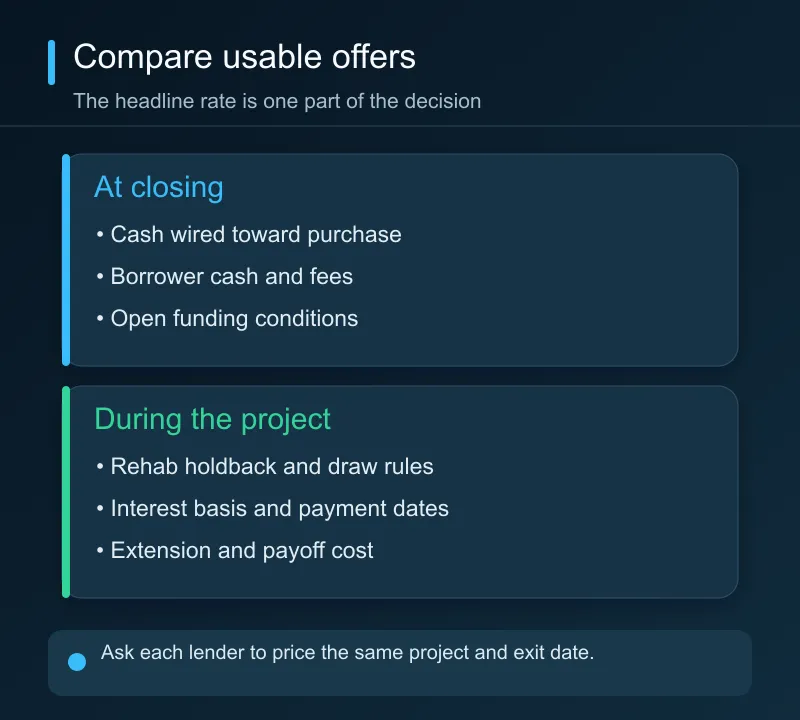
Compare the money you can use and the conditions for receiving the rest, as well as the rate.
Give every lender identical deal assumptions and ask for written terms. Compare these items in dollars and dates:
- Funding: Total commitment, amount wired at closing, renovation holdback, any reserves, and the borrower’s required cash.
- Cost: Rate, interest calculation, origination points, broker compensation, lender and third-party fees, draw fees, and extension or payoff charges.
- Time: Initial term, maturity date, payment dates, expected funding date, draw turnaround, and notice required for an extension.
- Conditions: Value or cost caps, approved scope, insurance, title, experience, credit, liquidity, and any personal guarantee or other collateral.
“Up to 90%” is incomplete without its denominator. It may refer to purchase price, eligible total cost, or a maximum after-repair value; another cap may also apply. The LTV, LTC, and ARV guide shows why the lowest cap and the rehab holdback determine usable cash.
Talk to the team that runs the loan
For a construction project, the draw process can matter more than a small rate difference. Find out whether money is advanced or reimbursed, which work must be complete before a request, what documentation is required, who inspects, and when a complete draw is normally paid. Ask how change orders and budget overruns are handled. If the contractor must be paid before reimbursement, you need working capital to bridge the gap. A sample draw request is more revealing than a promise of “fast funding.”
Get the fee schedule and a sample payoff calculation for your likely exit month and for a later month. A lender who explains both is easier to compare than one who talks only about the monthly payment. Confirm who can approve an extension, whether it is discretionary, and what it could cost.
Verify the counterparty
Match the lender’s legal name on the term sheet to the proposed loan documents and independently sourced contact information. Use the relevant state regulator for questions about licensing or registration; requirements depend on state and transaction type. If an intermediary is involved, identify the actual lender and the intermediary’s compensation. Be wary of anyone promising guaranteed approval in exchange for an unexplained advance payment. The FTC explains the difference between a legitimate disclosed application or appraisal fee and paying for a promise of credit.
The best choice is the offer that the project can close, use, and repay. If the numbers are close, weigh the quality of the written conditions and the lender’s response to difficult questions. Have a local real estate attorney review unfamiliar guarantees, cross-collateral terms, and default remedies before you sign.