
What secures a private real estate loan investment?
A loan can be “backed by a house” and still leave an investor with less protection than the phrase suggests. The property might secure the borrower’s debt to a lending company, while the investor owns a note from that company. Or the investor may own a participation whose rights depend on a lead lender. The first job is to connect the property collateral to your own agreement.
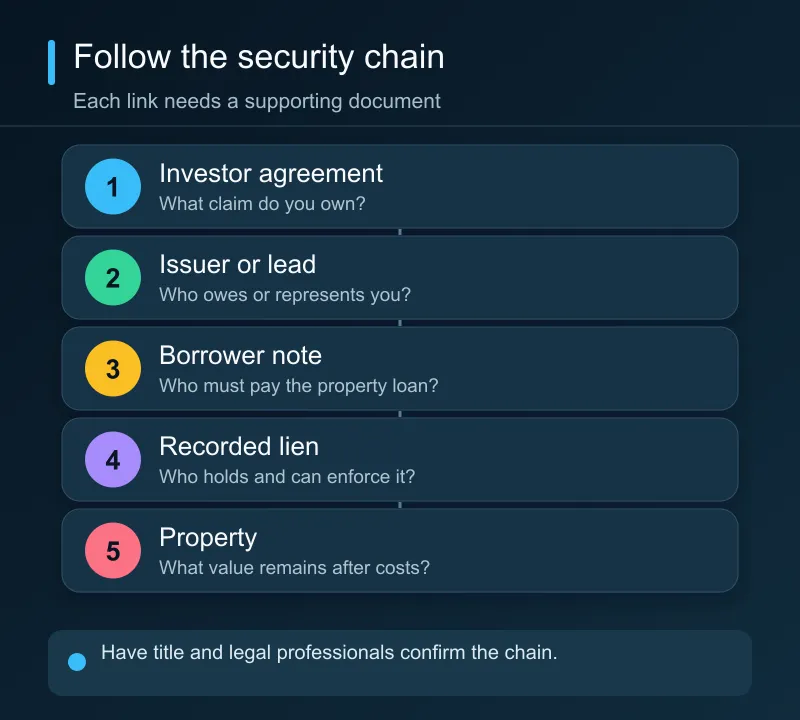
A property lien somewhere in the chain is not automatically the investor’s lien.
Find the documents, not just the label
For the underlying loan, request the executed borrower note, recorded mortgage or deed of trust, title commitment or policy, and any assignment or participation agreement. Confirm the borrower, property address, and legal description match across documents. Find out who holds the lien, its priority, and whether taxes, prior mortgages, mechanics liens, or other claims could sit ahead of it. A marketing statement that a loan is “first lien” is not a substitute for current title evidence.
The OCC’s commercial real estate handbook discusses the importance of matching collateral descriptions and monitoring liens in bank lending. An individual investment needs its own professional title review; rules and priorities vary by state.
Next, read the investment document. If you make the property loan directly, the security instrument may name you. If you buy a company-issued note, your security may be different from the company’s interest in its borrowers’ properties—or there may be no specific security at all. If you buy a participation, the lead lender may control collections and enforcement. Ask an attorney to draw the chain of assignments and rights, including what happens if the lead lender or issuer fails.
Value the collateral as it stands
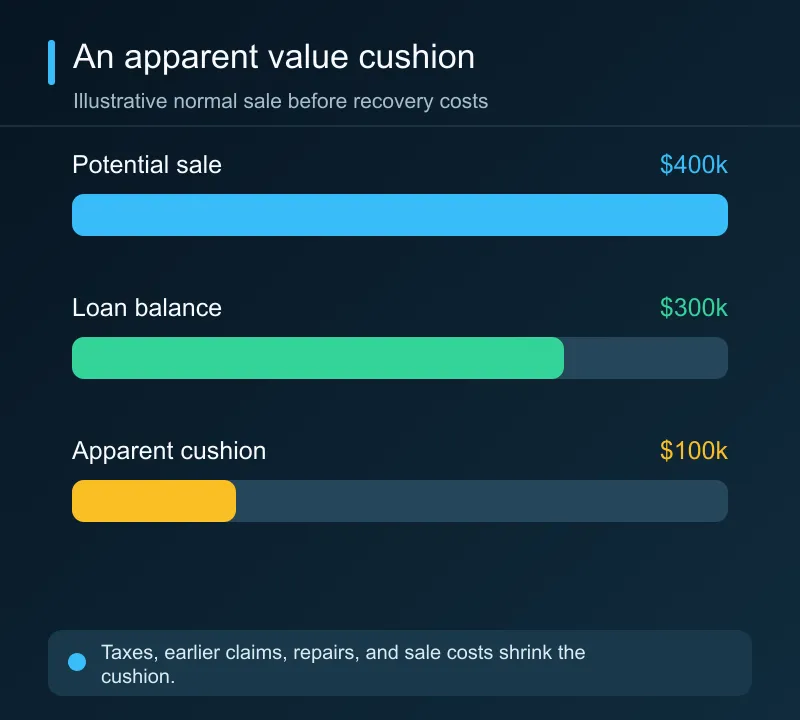
The difference between projected value and loan balance is not guaranteed recovery.
Suppose a renovated property could sell for $400,000 and the underlying loan balance is $300,000. The apparent $100,000 cushion can shrink after delinquent taxes, earlier claims, repair costs, legal work, insurance, carrying costs, and broker fees. If the renovation stops halfway, the property is not worth the completed-property estimate merely because the lender once accepted that estimate. Request both a current as-is assessment and support for the finished value, then test a lower sale price.
A lien is a way to seek recovery, not a guarantee of full repayment. The FDIC’s commercial real estate guidance treats repayment capacity, borrower equity, and collateral documentation as separate credit questions. A good loan needs a plausible ordinary payoff; collateral is what you examine for the case in which that plan fails.
Before investing, write a sentence you can verify from documents: “I have a claim against ___, secured by ___, with enforcement controlled by ___.” If any blank cannot be filled, you do not yet know what “secured” means for your money.