
How an investor can underwrite a private real estate loan
A property loan is not safe because the projected finished value exceeds the balance. The house may never be finished, or the sale may take longer and cost more than planned. When deciding whether to supply capital, test both the ordinary payoff and the less pleasant case in which the project stalls.
Write down the deal in one page
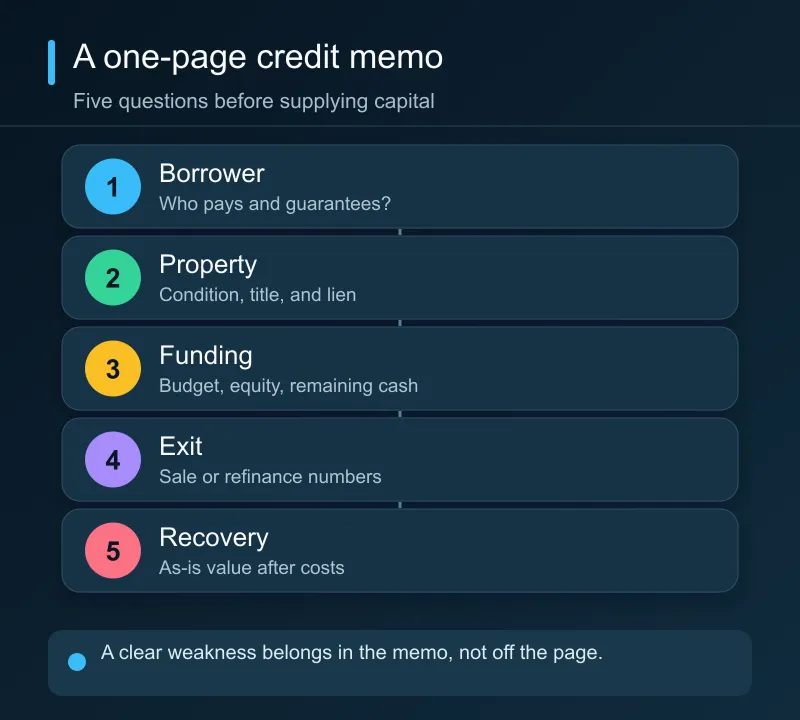
If a key number has no evidence, mark it as unknown rather than filling it with optimism.
Start with the legal borrower and any guarantors, the property, lien position, proposed loan amount, maturity, interest and payment terms, and how proceeds will be used. Add the purchase price, current condition, renovation or construction budget, committed borrower cash, and an independent value estimate. If an originator provides the file, ask which facts it verified and which came from the borrower.
Then describe the exit as an event with numbers and dates. A sale exit needs a defensible completed sale price, selling-cost estimate, and enough time to market and close. A refinance exit needs an actual prospective lender or program, likely appraisal, expected rent or income where relevant, closing costs, and a calculation of net proceeds. “Sell or refinance” written without either calculation is not two exits; it is two hopes.
Test the project’s ability to finish
For renovation and construction loans, compare remaining loan funds plus available borrower cash with the cost to complete, including contingency and carrying costs. Understand whether the lender reimburses completed work or advances money. A borrower with a profitable-looking sale can still run out of cash between draw requests. Review the contractor’s experience and whether permits and inspections match the schedule.
Suppose the loan is $300,000 against a projected $420,000 completed value, but $60,000 of work remains. If work stops, the completed-value figure is the wrong recovery estimate. Use a supportable as-is value, account for unfinished work, senior claims, legal and sale costs, and time. The FDIC’s commercial real estate guidance identifies thin borrower liquidity, unsupported collateral values, and speculative repayment as credit concerns.
Challenge the source of repayment
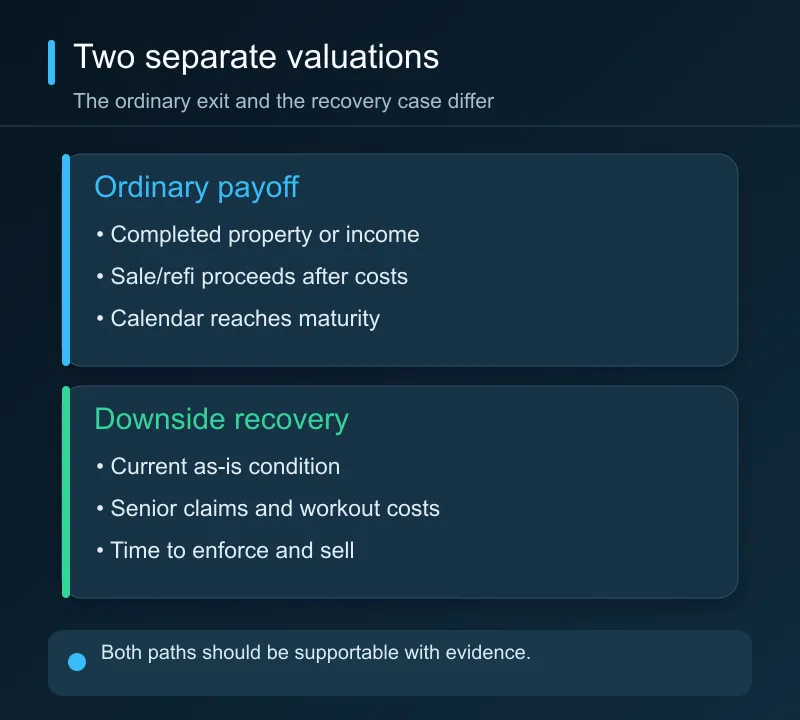
Do not use a completed-property estimate as the value of an unfinished job.
Ask what happens after a lower appraisal, a slower sale, higher costs, or a delayed refinance. Does the borrower have other liquidity or a guarantor who could actually perform? Are there earlier loans on the borrower or property? Has the borrower completed projects of this type, or is the budget based on unfamiliar work? State the main weakness in the memo. If you cannot do that, the analysis may be a sales summary rather than underwriting.
Do not rely entirely on the originator’s memo. The FDIC’s purchased-loan guidance tells banks to analyze purchased loans and participations independently; the underlying lesson is useful for private capital too. Hire an appraiser, title professional, contractor, attorney, or servicer where your own expertise ends. A loan you cannot understand well enough to stress-test may not be one you should fund.