
Quoted yield vs. the return an investor receives
A borrower rate is not an investor return. Even the coupon on an investor’s note is only a promise calculated under its terms. What the investor earns depends on when capital is deployed, what fees and losses come out, and when cash is actually paid back.
Start with the cash you put in
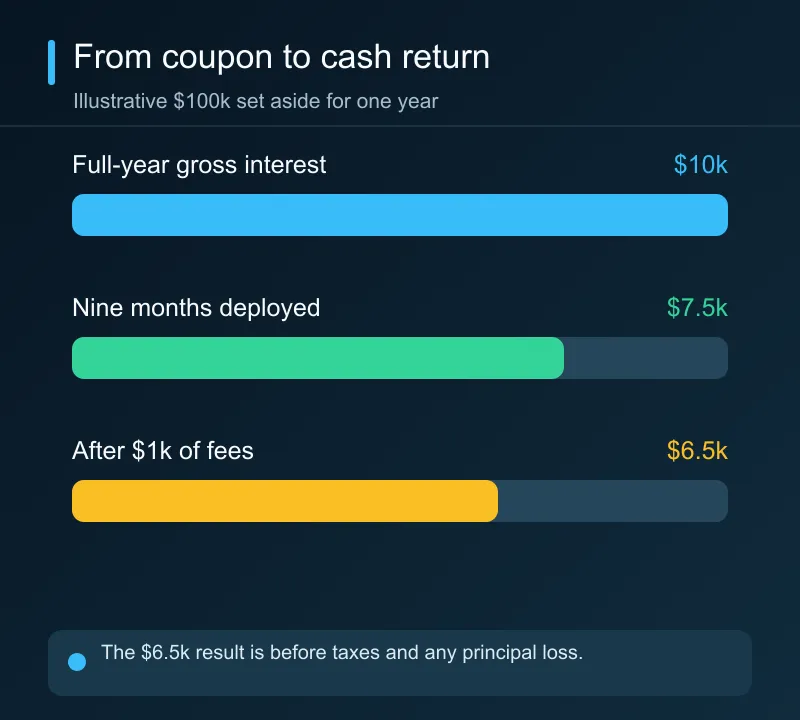
The stated coupon and the investor’s cash result diverge when capital sits idle or fees apply.
Suppose an investor sets aside $100,000 for twelve months and finds a loan paying a stated 10% annual simple coupon. If the full $100,000 earns interest for the whole year and every payment arrives, gross interest is $10,000. If the money is deployed for nine months and idle for three, gross interest is about $7,500 under that simplified assumption. If the investor pays $1,000 in fees, cash earnings are $6,500 before taxes or loss—6.5% of the $100,000 set aside over the twelve-month period. The advertised 10% has not changed; the investor’s actual cash experience has.
Real arrangements may accrue interest daily, hold reserves, distribute on a schedule, or pay interest only at payoff. Ask whether a reported return is based on committed capital, invested capital, or the balance actually outstanding. A fund’s target yield may be before management and servicing fees; an originator may retain part of the borrower rate. The SEC’s fee bulletin explains why even charges that are not separately billed to an investor reduce results.
Treat unpaid income carefully
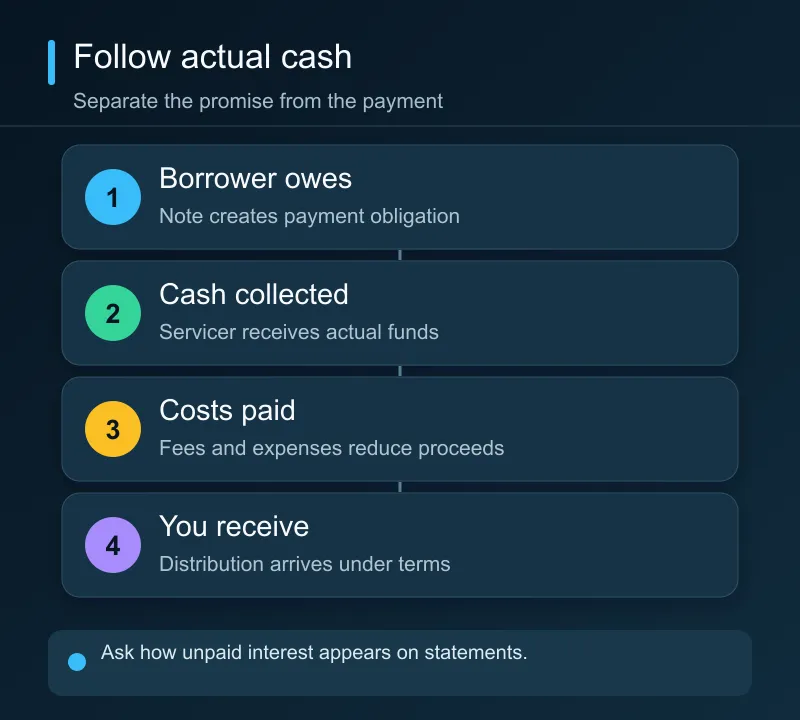
Accrued interest is not the same as money distributed to the investor.
An investor statement may show accrued interest while the borrower has not paid it. An extension may add interest to the balance rather than send cash to investors. Those amounts are economically different from money in your account. Ask how delinquent interest is reported, when a loan stops accruing for performance presentations, and whether late fees or extension fees belong to the investor or the operator.
Losses can overwhelm several good coupons. A $10,000 principal loss on one $100,000 loan is not offset by calling the other loans “10% deals.” Compare a manager’s realized, net results across loans that have reached an outcome, including extensions, workouts, legal costs, and charge-offs. Also look at active loans, since a young portfolio may not yet have faced many maturity dates.
Put timing beside amount
Two investments can return the same total dollars but feel different if one pays monthly and the other returns everything after a two-year workout. If you need cash at a certain date, a delayed payoff can force an unwelcome sale of another asset. Compare the dates and amounts of expected cash flows with a delayed case. If the investment is a fund interest, read distribution and withdrawal rules; the fund may retain cash or limit redemptions even as some underlying loans pay off.
The SEC’s private-placement guide warns that these investments can be illiquid and can lose principal. A quoted yield is a starting assumption for a cash-flow model, not the model’s conclusion.