
Liquidity and concentration in private real estate credit
A twelve-month property loan can hold an investor’s capital for much longer than twelve months. The borrower may extend, miss a payment, or require a workout; a fund may restrict withdrawals even while some borrowers pay on time. Before investing, decide how much cash you can leave committed through a delayed outcome, not just through the advertised term.
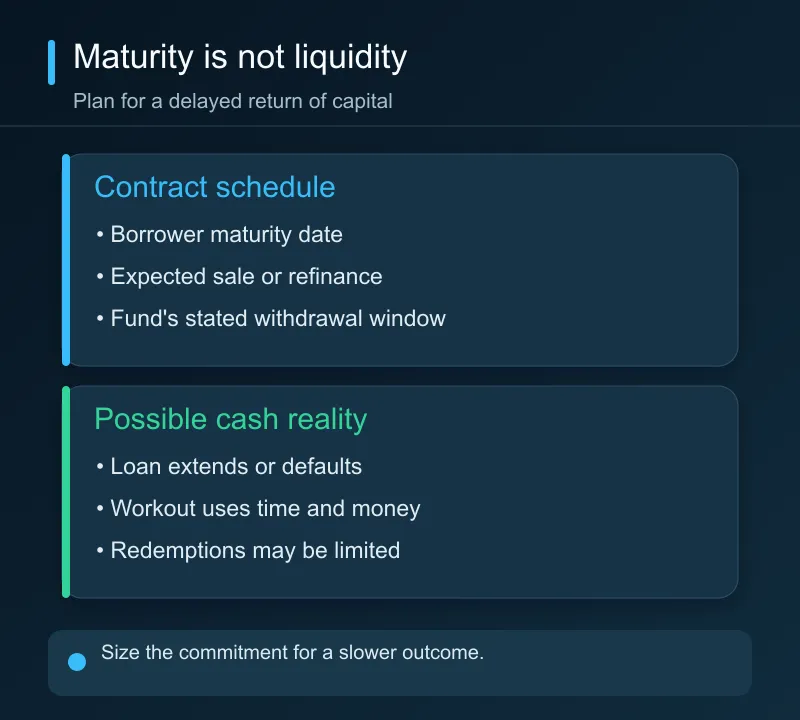
A scheduled payoff is not a promise of cash in the investor’s account that day.
Read the exit from your investment
A direct loan typically returns principal when the borrower pays or when a recovery produces cash. Selling that loan to someone else may be possible but there may be no ready buyer. A participation can limit transfers through its agreement. A private fund may accept redemption requests at specified times yet defer or limit them under its documents. The SEC’s private-placement bulletin explains why restricted investments can be hard to resell.
Ask what happens if several loans extend at once. Can an operator meet investor withdrawal requests without selling loans at a discount or borrowing against the portfolio? Are there unfunded construction commitments that require more cash while existing loans remain outstanding? Put expected inflows and required outflows on the same calendar.
Count shared exposures, not just properties
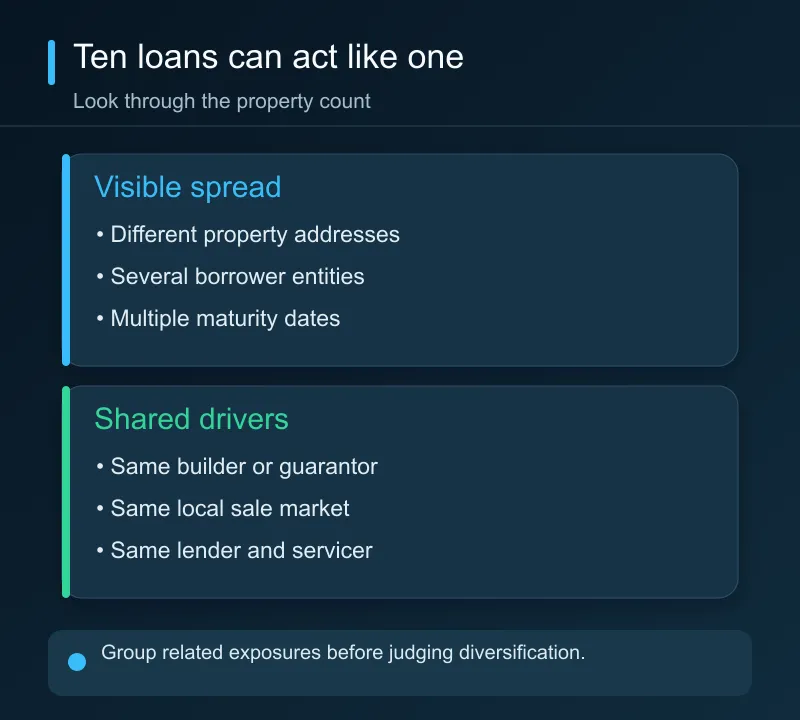
Counting loans alone can conceal concentrated exposure.
Ten loans do not necessarily mean ten independent risks. Several may rely on one builder, one sponsor, one neighborhood, the same insurer, or a refinance market that could tighten for all of them. A fund can reduce exposure to one property while concentrating exposure to one manager and its underwriting process. List the portfolio by borrower and guarantor, geography, property type, loan stage, expected maturity, originator, and servicer. Look through multiple entities owned by the same sponsor.
The SEC’s diversification guide notes that spreading investments can reduce concentration risk, but a narrowly focused fund may still leave investors exposed to the same underlying drivers. Private real estate loans are themselves one part of a broader portfolio; owning several similar loan funds does not automatically diversify it.
Set a limit you can live with
A practical test is to model multiple loans paying six or twelve months late and one losing principal. Would that force you to sell a different asset, miss an obligation, or borrow for ordinary expenses? If so, the commitment may be too large or too hard to exit for your cash needs. The right allocation depends on the investor’s circumstances, but the question is concrete: can you wait through a workout and absorb a loss without depending on a promised redemption date?