
Red flags when evaluating a hard money lender
A legitimate private lender may move quickly, charge upfront third-party costs, and use a loan structure unfamiliar to a first-time borrower. None of those facts alone proves a problem. The warning sign is a mismatch between what someone promises and what you can verify in writing.
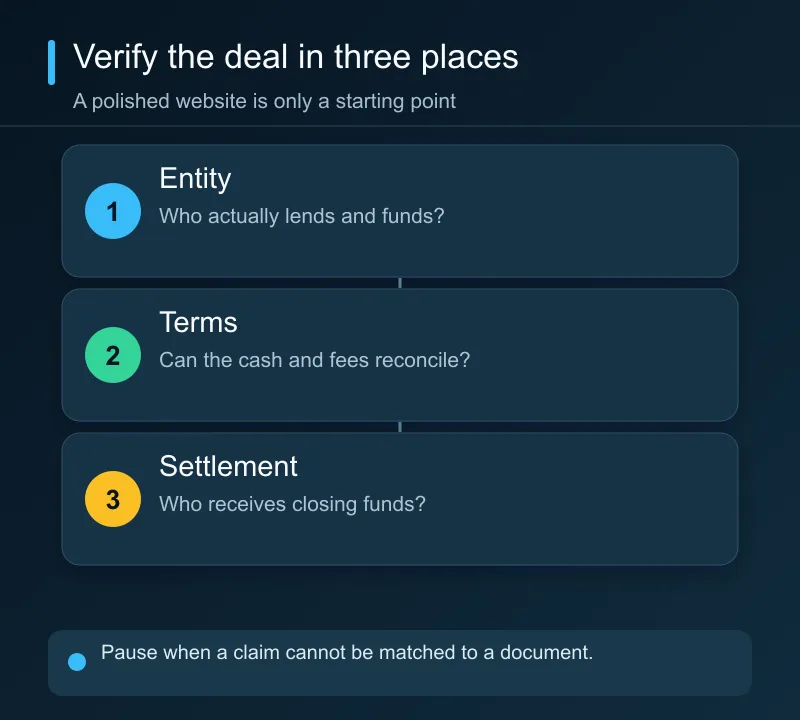
Identity, loan economics, and closing instructions are separate checks.
Know who is on the other side
Find the company’s legal name and business contact information independently. Does the person quoting the loan work for that entity, a broker, or a lead generator? Ask which entity will appear as lender on the note and which will fund it. A broker can be useful, but its role and compensation should be clear. A website with a form and testimonials is not enough to establish who will lend your money or handle your documents.
Check the relevant state financial regulator for licensing or registration questions. Requirements vary by state and by whether the transaction is consumer or business purpose; a missing result in one consumer mortgage database is not, by itself, a verdict. If the person is asking for a large payment or sensitive financial records before identifying the company and loan process, slow down.
Demand numbers you can reconcile
A quote should let you calculate cash to close, held construction funds, required payments, maturity, and likely payoff. If the lender speaks only in a headline rate or “up to” leverage percentage, request an itemized term sheet. Watch for fees, guarantees, cross-collateral, default interest, or extension conditions that appear late without an explanation. Changes may have a legitimate cause—new title, valuation, or borrower information—but you deserve to know the cause before signing.
Be especially cautious of a guaranteed approval in exchange for a payment that supposedly unlocks the loan. The FTC’s advance-fee guidance explains that a legitimate lender may charge a disclosed application or appraisal fee, but paying for a promise of credit is a different matter. The FTC also advises businesses to identify who receives their financial information in an online financing application.
Treat wire changes as a stop sign
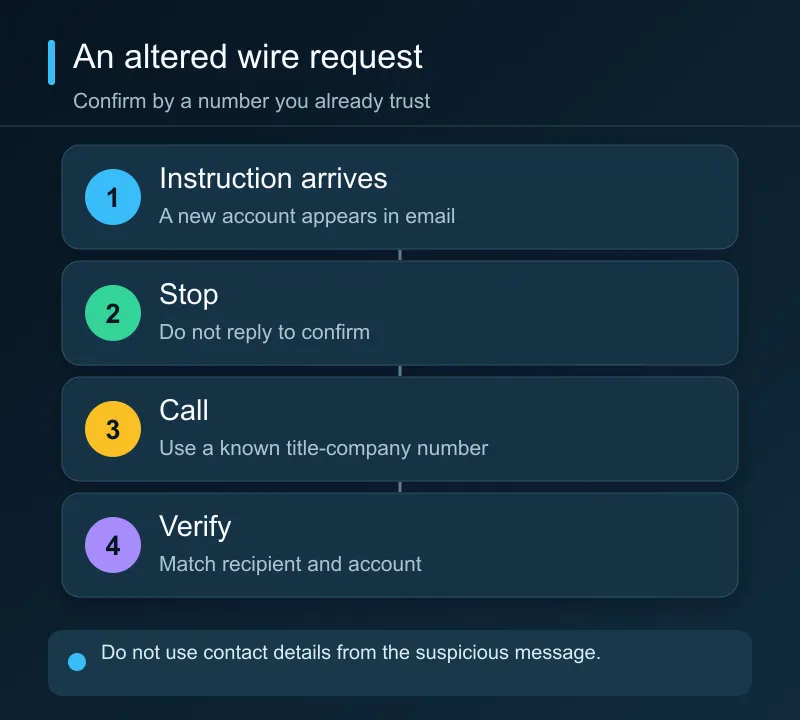
A changed email instruction should trigger an independent phone check.
Before closing, call the title or settlement company at a number you obtained independently to verify wire instructions. If an email suddenly changes the destination account, do not reply to that email to confirm it. The CFPB describes how closing-wire fraud works. The same verification step matters for an investment-property closing.
A real company can still offer a bad loan. Separate identity verification from deal evaluation. Verify the counterparty, then have a real estate attorney review unfamiliar provisions and compare the all-in cost with other written offers. Pressure to sign before you can do either is information in its own right.