
Lending directly vs. becoming an LP in a hard money lender
Imagine you have capital you want to put into property lending. A builder offers you a loan on one renovation. At the same time, a hard money lender invites you to invest as a limited partner. Both pitches may talk about the same houses and borrowers. They are not the same investment.
With a direct loan, your money goes to a borrower under a note, usually with a lien on a specified property. With an LP interest, your money goes into a partnership; the partnership agreement determines what you receive. The partnership might hold a pool of loans, or it might own part of the operating lending company. That difference comes before any comparison of advertised returns.
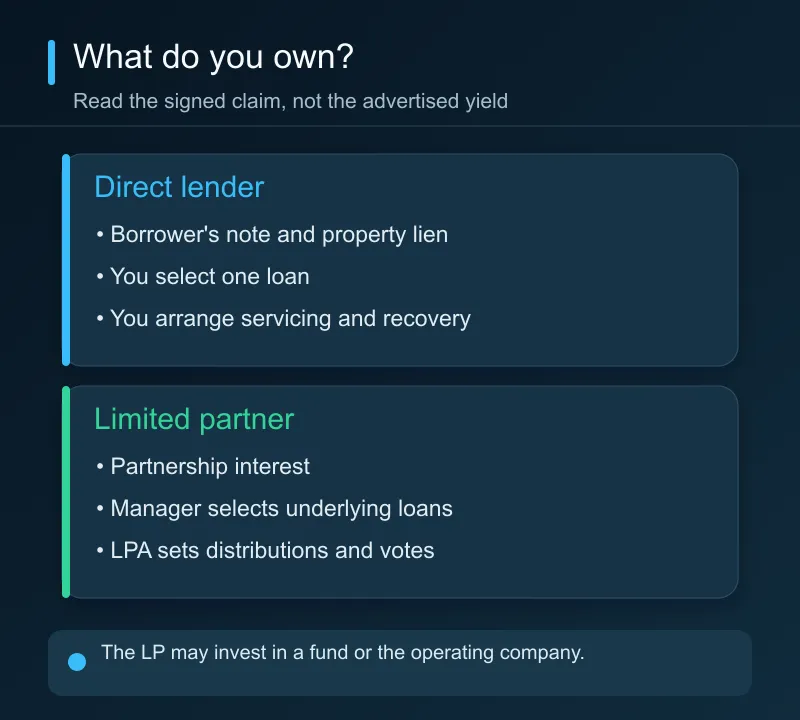
The property may be the economic source in both routes, but the investor’s legal claim differs.
First, identify the LP entity
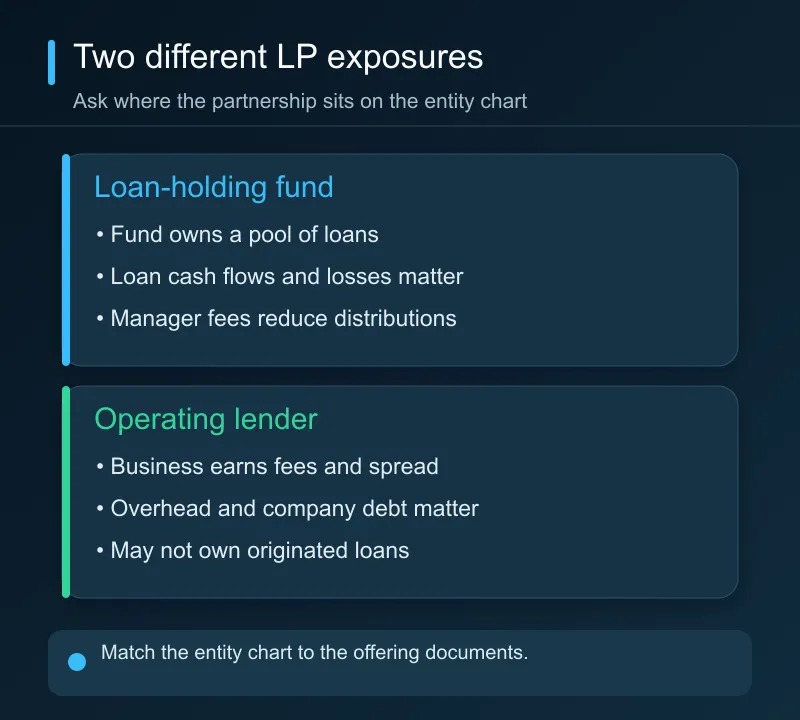
The words ‘LP in a lender’ do not tell you which entity owns the loans.
Ask for an entity chart. If you are joining a loan-holding fund, the fund may own loans that a manager originates and services. Fund income and losses flow through the fund’s agreements before reaching LPs. If you are buying into the operating lender, your result may depend on origination revenue, staffing and overhead, borrowing, servicing performance, and growth in the business. The operating company may not own the loans it arranges or originates. In either case, an LP interest does not ordinarily make you the named lender on a property’s mortgage.
The label “partner” does not settle the question. Read the offering memorandum, partnership agreement, and entity chart to see exactly where your capital sits, which entity owns the loans, and whether another entity receives fees. The SEC’s private-fund guide explains that a limited partnership agreement can set capital calls, profit sharing, management fees, and withdrawal rights. It also notes that a fund and its management company can be separate entities.
Compare the work and the control
As a direct lender, you can decide which borrower and property to finance and negotiate the amount, rate, maturity, draw conditions, and security. But you must either do or pay for the work: verify title and value, review the builder and budget, document the loan, monitor insurance and taxes, handle draws, collect payments, and respond to a default. Hiring an originator or servicer does not make those questions disappear; the contract must say who can change terms and who can enforce the lien. The FDIC’s guidance for banks buying loans emphasizes independent credit analysis and clear rights. It is not a rule for an individual lender, but the discipline is useful.
As an LP, you delegate most of that work. You may gain access to a manager’s pipeline and systems, but you usually cannot reject one ordinary loan, direct a construction draw, or decide when to foreclose. Read the voting, reporting, manager-removal, and conflict provisions. Ask what happens if the manager leaves, the servicer fails, or you disagree with a loan extension. The ability to receive a quarterly report is different from the power to change an outcome.
Compare risk and net return
A direct loan concentrates capital in one borrower, one property, and one exit. If the project succeeds, you receive what the note promises, less your own origination, servicing, legal, funding, and tax costs. If it fails, recovery depends on collateral value, lien priority, time, costs, and any guarantor—not simply the original appraisal.
A loan fund can spread capital across properties, but inspect its actual portfolio. Several loans may share one market, builder, or originator. The fund may use leverage and may charge management, servicing, or performance fees. The operating-company LP has a different exposure: even good underlying loans may not produce a good equity return if expenses or company debt consume earnings. Ask whether the quoted LP return is a target, a preferred-return provision, or cash that has actually been distributed. A preferred return sets a contractual priority; it cannot create profit that does not exist. The SEC’s fee guidance is a reminder to compare returns after expenses.
Cash timing differs too. A direct loan may pay monthly interest and principal at payoff, or follow another schedule. An LP may receive distributions only when the partnership has distributable cash, and it may call for additional capital under the agreement. A borrower rate should never be compared directly with an LP’s projected net yield. Model actual cash invested and received over the same period.
Plan for getting out
A direct loan is tied to borrower repayment or the outcome of a workout. Selling the loan before payoff may be difficult. An LP interest may restrict transfer or withdrawal even after some underlying loans repay. The SEC’s private-placement bulletin warns that these investments can be illiquid and may lose principal. Ask what the documents allow if you need cash early, and what happens when a loan or the lending business runs into trouble.
Before deciding, put two document sets on the table. For the direct loan: borrower note, lien instrument, title evidence, valuation, budget, servicing plan, and downside recovery. For the LP: offering documents, partnership agreement, entity chart, financial statements, portfolio performance, fee schedule, capital-call terms, and distribution history. Qualified real estate, securities, and tax advisers can help interpret the specific deal. The choice is not simply active versus passive; it is a choice between direct exposure to a loan you control and an interest in a business or pool whose decisions you largely entrust to others.